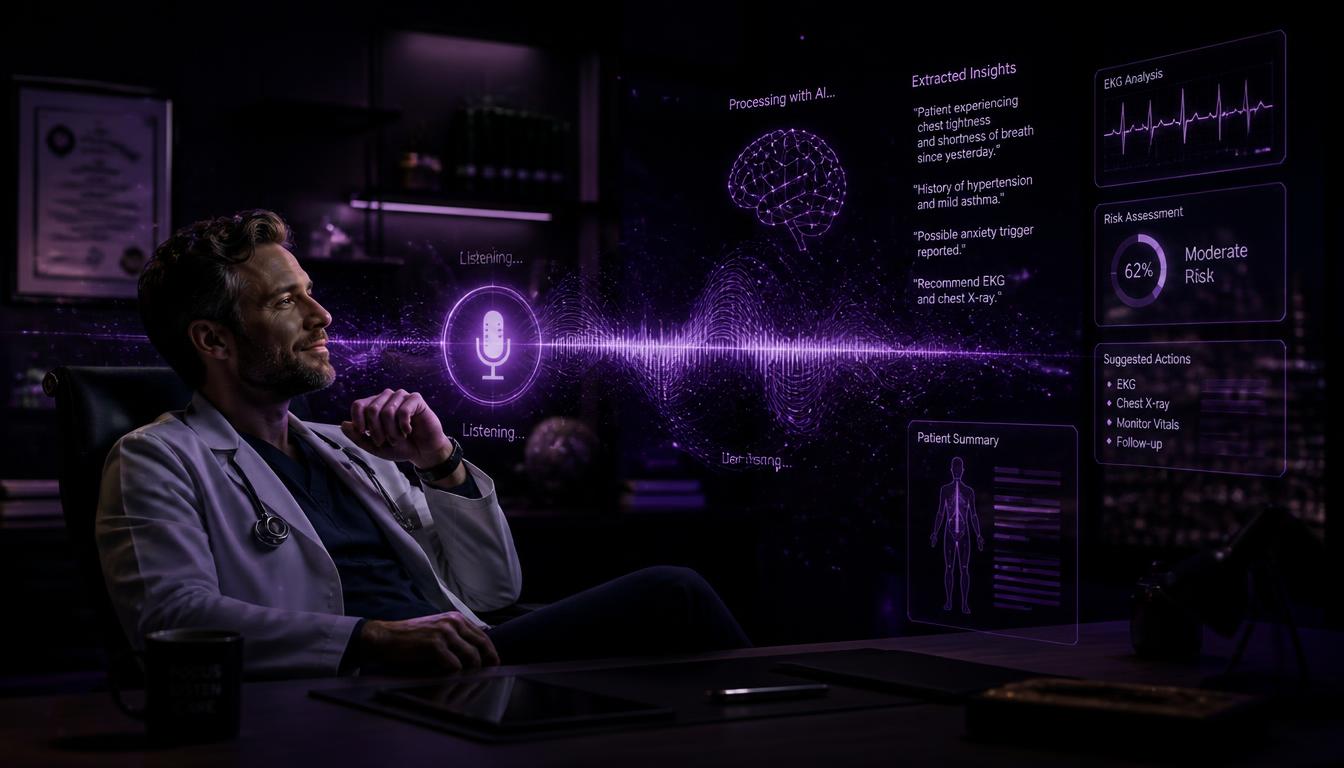
Physician burnout is a global healthcare crisis. In the USA alone, over 50% of physicians report significant burnout symptoms, and documentation burden is the leading cause. The average physician spends 50% of working hours on administrative tasks, primarily documentation. Ambient clinical documentation technology uses AI to automatically generate complete clinical notes from natural physician-patient conversations, returning those hours to patient care.
What Is Ambient AI Scribe Technology?
Ambient AI scribe systems use microphones (room-mounted, badge-worn, or smartphone-based) to listen to physician-patient conversations during clinical encounters. Natural language processing and medical speech recognition analyze the conversation in real time, identifying clinical entities (symptoms, diagnoses, medications, procedures), and automatically generating structured clinical documentation in the EMR format the physician expects, without any physician typing, dictating, or reviewing structured templates.
Clinical Documentation Output
Ambient AI generates complete clinical notes including SOAP notes (Subjective, Objective, Assessment, Plan), History & Physical examinations, Follow-up progress notes, Discharge summaries, Consultation notes, and Procedure notes. The AI differentiates clinically significant conversation from small talk, captures patient-reported symptoms with appropriate language, and formats documentation to meet quality standards for billing and compliance.
Time Savings: The Evidence
Published studies on ambient AI scribe deployment report consistent results: physicians save 1.5–3.5 hours per day on documentation. For a physician seeing 25 patients daily, this represents 4–8 minutes saved per encounter. Multiplied across an entire medical staff, these savings translate to hundreds of additional patient capacity per week without adding providers.
Patient Experience Impact
When physicians are not typing during appointments, they make more eye contact, engage more deeply with patient concerns, and spend more time listening. Patient satisfaction scores improve 15–20% at practices deploying ambient scribes, not because care changed clinically, but because patients feel heard rather than processed. The physician-patient relationship improves when documentation happens invisibly in the background.
Integration with EMR Workflows
Quecorex Ambient Scribe integrates directly within the EMR interface. After each encounter, the generated note appears in the physician's documentation queue for rapid review (typically 1–2 minutes to review and sign versus 10–15 minutes to write from scratch). Physicians can edit, add context, or modify sections using voice commands or keyboard. The reviewed note becomes the signed legal medical record.
Accuracy and Clinical Validation
Medical ambient AI achieves 90–95% documentation accuracy for straightforward encounters. Complex multi-problem visits, patients with accents, and specialties with highly technical vocabulary require additional fine-tuning. Continuous learning improves accuracy over time as the AI adapts to individual physician documentation styles and specialty-specific terminology.
Concerned about accuracy? Request a pilot program to test ambient scribe with your physicians.
Privacy and Compliance
Patient consent is required before recording. Recordings are processed and immediately discarded, the clinical note, not the audio, is the permanent record. HIPAA-compliant data processing with BAAs, GDPR compliance for European deployments, and end-to-end encryption protect patient privacy at every step of the documentation pipeline.
Specialty Applications
Ambient AI performs particularly well in high-documentation-burden specialties: Primary Care (complex multi-problem visits), Psychiatry (long session notes), Orthopedics (procedure documentation), Oncology (complex treatment discussions), and Internal Medicine (detailed hospital progress notes). Specialty-specific documentation templates improve out-of-box accuracy for each clinical context.
ROI Analysis
At $30,000/year physician compensation for documentation time saved (2 hours/day × $75/hour × 250 days), ambient AI pays for itself in months. Additionally, burnout-related physician turnover costs $500,000–$1,000,000 per departure in recruitment, onboarding, and productivity loss. Preventing even one turnover event covers years of ambient AI subscription costs.
Ready to reduce physician burnout and save documentation time? Book a tailored Quecorex Ambient Scribe demo.
Running a Pilot That Tells You the Truth
- Pick a small, willing group. A few clinicians across different specialties and styles.
- Measure a baseline. Time spent on documentation, after-hours charting, and note completion time.
- Obtain patient consent. Explain what is recorded, how it is used, and how to opt out.
- Require review. Clinicians read and edit every note before signing.
- Track errors. Record omissions, wrong details, and invented content, and how often they occur.
- Survey clinicians and patients. Ask about experience, not just time.
- Decide with data. Expand, adjust, or stop based on the results.
Risks to Manage
| Risk | Mitigation |
|---|---|
| Inaccurate or invented content | Mandatory clinician review and error tracking |
| Patient privacy and consent | Clear consent, encryption, and defined retention of recordings |
| Accents, languages, and noisy rooms | Test in real conditions with your patient mix |
| Over-reliance | Training that reinforces clinician responsibility |
| Vendor data use | Written limits on training with your data |
Estimate documentation time savings with the ROI calculator. AI features have no monthly module fee; you buy AI credits and pay for what you use. See the pricing estimator for the modules that do carry a fee. Related: discharge summary automation.
What Documentation Burden Looks Like
Clinicians often spend a large part of their working day on documentation, including time after clinic hours, which contributes to fatigue and dissatisfaction. Tools that draft notes from a recorded consultation aim to give some of that time back and to let clinicians face patients rather than screens. The benefit depends on note quality, editing effort, and workflow fit. Measure it yourself with a baseline before the pilot: minutes per note, after-hours charting, and time to sign-off.
Note Quality and Specialty Fit
| Specialty | Considerations |
|---|---|
| Primary care | Wide range of topics, many short visits, need for problem-oriented notes |
| Surgery and procedures | Structured operative notes may fit templates better than free conversation |
| Mental health | Sensitive content, need for careful consent and note separation |
| Paediatrics | Multiple speakers and family dynamics |
| Emergency | Noisy environments and interrupted encounters |
Ask vendors for examples in your specialty, and test with accents, noise, and interpreters typical for your patients.
Governance Checklist
- Written policy on recording and consent, including how patients can decline.
- Clear retention rules for audio and transcripts, and deletion when no longer needed.
- Rules on where processing happens and who can access data.
- A process for reporting errors and unsafe outputs.
- Clinician training that stresses reviewing every note.
- Regular audit of a sample of notes for accuracy.
For clinic-level context see the small clinic software guide and for the ward side, nursing management software.
Conclusion
Ambient clinical documentation represents a fundamental shift in how physicians interact with EMR systems. Documentation becomes automatic, invisible, and accurate, freeing physicians to focus on the clinical reasoning, patient connection, and care coordination that only humans can provide. Quecorex Ambient Scribe is available as part of the AI clinical suite for any specialty and practice size.