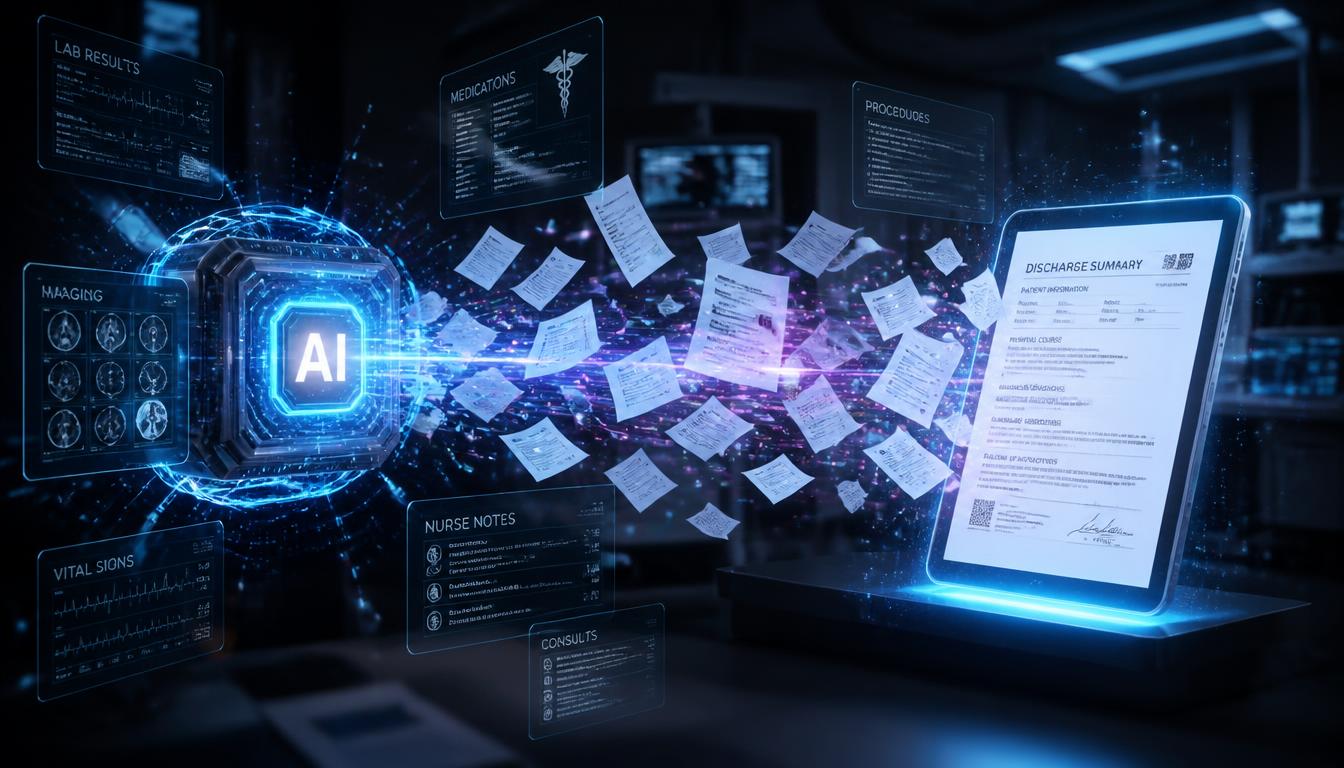
Hospital discharge summaries are critical clinical documents, summarizing the inpatient admission, communicating care plans to outpatient providers, and guiding patient self-management after discharge. Yet discharge summary documentation is notoriously burdensome: the average attending physician spends 30–45 minutes composing each summary, often from memory at the end of an exhausting clinical day. AI discharge summary automation synthesizes the entire inpatient encounter into a complete, accurate discharge summary in under 2 minutes.
What AI Discharge Summaries Include
AI-generated discharge summaries include all required elements: admission diagnosis, hospital course (procedures performed, significant events, treatment response), discharge diagnoses with ICD-10 codes, discharge medications with reconciliation against pre-admission medications, discharge condition and functional status, follow-up appointments scheduled, pending results requiring outpatient review, and patient education provided. The AI synthesizes these elements from progress notes, orders, lab results, operative reports, and nursing documentation automatically.
Care Transitions Safety
Poor discharge summaries are a leading cause of preventable readmissions. When primary care physicians receive incomplete discharge summaries, missing active medication changes, unclear follow-up instructions, or absent pending result notifications, post-hospital care gaps develop. AI discharge summaries that comprehensively capture all transitions-of-care information reduce readmission rates by 15–20% through improved post-discharge care continuity.
Joint Commission Compliance
The Joint Commission's standards for discharge summaries (NPSG 02.05.01) require specific content elements including reason for hospitalization, significant findings, procedures performed, condition at discharge, discharge instructions, and follow-up plan. AI discharge summaries are pre-validated against these standards, with automatic flagging when required elements are missing before physician signature.
Specialty Discharge Documentation
Surgical discharge summaries include operative findings, procedure details, implants used, surgical site care instructions, and activity restrictions. Cardiac discharge summaries include catheterization findings, ejection fraction, rhythm at discharge, and cardiology follow-up plans. Oncology summaries include treatment received, response assessment, next treatment cycle plans, and toxicity management instructions. AI templates adapt to specialty context automatically.
Patient-Friendly Discharge Instructions
Beyond the clinical discharge summary (for providers), AI generates patient-friendly discharge instructions in plain language matched to patient health literacy level. Medication instructions use plain names rather than pharmacological terminology. Activity restrictions are expressed in everyday language. Warning signs requiring emergency care are explicitly listed. These instructions can be generated in multiple languages for non-English speaking patients.
Time Savings Analysis
At 30 minutes saved per discharge summary, for a hospitalist seeing 15 discharges per week, AI saves 7.5 hours weekly, nearly an entire workday returned to clinical care, rest, or work-life balance. For a hospital with 100 annual discharges per bed (a typical rate), AI discharge summaries generate thousands of hours of physician time savings annually.
Ready to optimize your Discharge Summary Automation Ai Healthca workflows? Book a tailored Quecorex demo today.
What a Good Discharge Summary Contains
| Element | Why the next clinician needs it |
|---|---|
| Reason for admission and diagnoses | Context for follow-up care |
| Key procedures and results | What was done and what was found |
| Medications on discharge, with changes and reasons | Prevents duplication and omissions |
| Pending tests | Results that still need action |
| Follow-up plan and appointments | Continuity of care |
| Patient instructions and warning signs | Safe recovery at home |
Keeping a Human in the Loop
Automated drafts save time, but the discharging clinician is responsible for the final document. Set a simple process: the system assembles a draft from the record, the clinician reviews and edits it, and only then is it signed and sent. Track how often drafts are edited and which sections change most. That feedback shows where the automation needs improvement and where it can be trusted.
Measures of Success
- Time from discharge to summary sent to the next provider.
- Share of summaries completed within your target window.
- Clinician time spent per summary before and after.
- Errors found in review, by type.
- Readmissions linked to information gaps, reviewed qualitatively.
Estimate the value of saved time with the ROI calculator. AI features have no monthly module fee; you buy AI credits and pay for what you use. See the pricing estimator for the modules that do carry a fee. Read our guide to ambient clinical documentation for related workflow lessons.
Discharge Safety: What Goes Wrong Without a Good Summary
When patients leave hospital, their care passes to a family doctor, community team, or family. If the summary arrives late or lacks key facts, the next clinician may not know that a medicine was stopped, a test is pending, or a follow-up is needed. Common failure points are missing medication changes, no clear owner for pending results, vague follow-up instructions, and summaries that arrive days after the first appointment. A good process assigns responsibility, sets a target time for the summary to be sent, and checks that the right recipient receives it.
Medication Reconciliation at Discharge
| Category | What the summary should say |
|---|---|
| Continued | Medicines the patient was on before and should keep taking |
| New | Medicines started in hospital, with dose, duration, and reason |
| Changed | Dose or frequency changes, with the reason |
| Stopped | Medicines that should no longer be taken, with the reason |
| Allergies and adverse reactions | Anything new discovered during the stay |
Errors here are among the most common causes of harm after discharge, so this section deserves the most clinician attention when reviewing a draft.
Language, Literacy, and Format
- Give patients a plain-language version with warning signs and who to call.
- Offer translated instructions where your patients need them, reviewed by a qualified person.
- Send the clinical summary to the next provider through a secure route, not only to the patient.
- Make the summary available in the patient portal so it is easy to find.
- Record that the summary was sent and to whom.
The inpatient record that feeds the summary is described in nursing management and eMAR.
Looking Ahead
Discharge summary automation addresses a genuine pain point for hospital physicians while simultaneously improving quality of care transitions. Quecorex AI Discharge Summary integrates directly with the inpatient EMR, generating complete summaries for physician review from existing clinical data without any additional data entry.