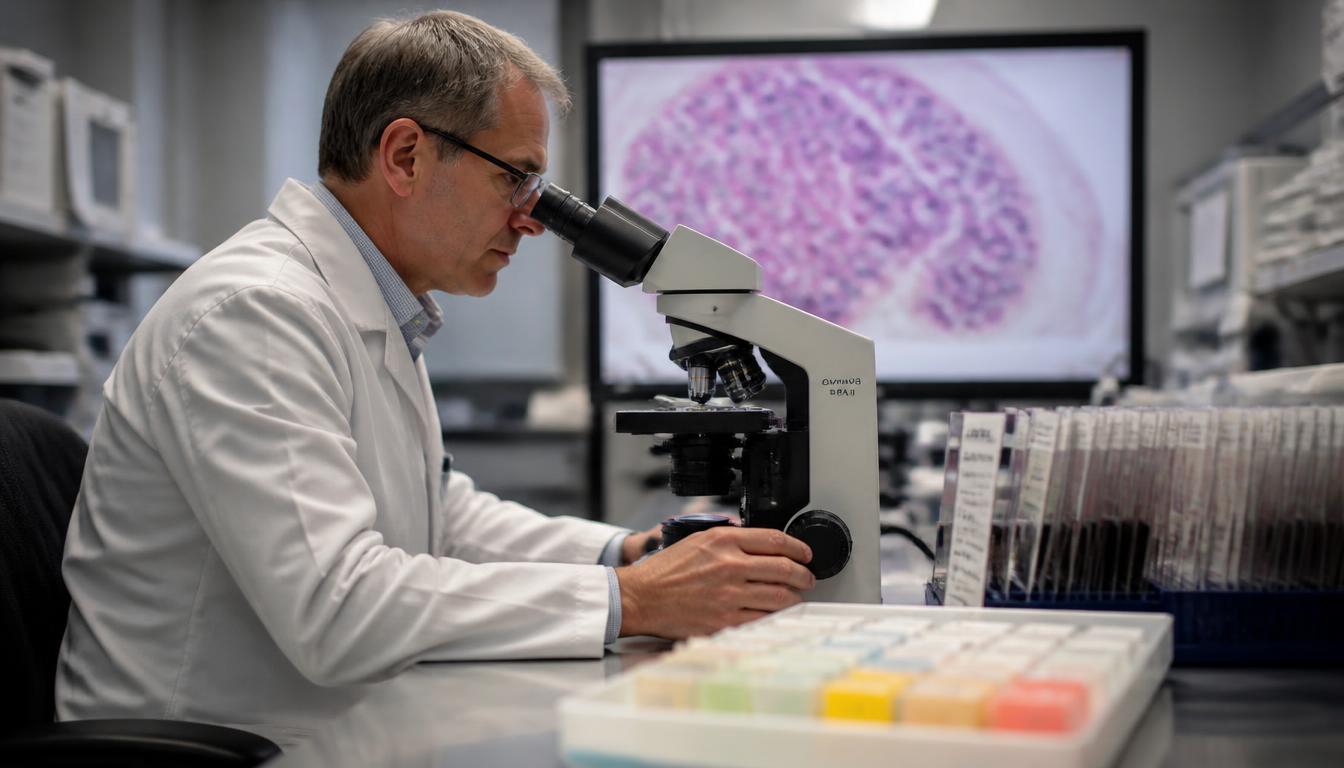
Anatomic pathology is where diagnosis becomes final. A biopsy from the dermatology clinic, a polyp from the endoscopy suite, a prostate core from the urology procedure room: each one ends up on a pathologist's desk, and the report that comes back decides treatment. The workflow is long and unforgiving: accession, gross examination, processing, embedding, slides, stains, microscopy, sign-out, and often molecular testing. A mislabeled block or a lost specimen is a patient-safety event. Anatomic pathology software keeps the chain of custody intact, structures the report, and links every result back to the clinician who ordered it.
This guide is for pathology department heads, laboratory directors, and hospital IT leaders evaluating anatomic pathology LIS options. It covers workflows to require, how the main approaches compare, pricing, and how to plan a rollout.
Why General Laboratory Systems Struggle With Anatomic Pathology
- Specimens are not tubes. Anatomic specimens have gross descriptions, dimensions, blocks, margins, and fixation times that a clinical chemistry LIS was never designed to hold.
- Reports are narrative and structured at once. A modern cancer report needs both a microscopic description and structured synoptic data elements, such as those defined in College of American Pathologists (CAP) cancer protocols.
- Ancillary tests multiply. Immunohistochemistry stains, frozen sections, and molecular tests attach to the same case and must be tracked to completion.
- Turnaround time is a headline metric. Clinicians and patients wait for a diagnosis, and without timestamps the department cannot see where cases stall.
- Traceability is non-negotiable. From collection to storage, every handoff must be recorded for accreditation and patient safety.
Core Workflows an Anatomic Pathology System Must Support
1. Specimen Management and Chain of Custody
Specimen records start with the accession number, specimen type and source, collection and received dates, collector, ordering provider, clinical history, and priority. Chain of custody entries record each handoff with timestamp, action, handler, location, and specimen condition. Gross examination stores the description, dimensions, blocks submitted, and whether margins were inked, and processing stores the protocol, fixative, fixation time in hours, and decalcification. Rejected specimens carry a rejection reason. This is the foundation for both patient safety and accreditation inspections.
2. Surgical Pathology and Synoptic Reporting
Surgical pathology cases store the report type, microscopic description, final diagnosis, a malignant flag, and the signing pathologist. Synoptic data is captured as structured key and value pairs, so cancer protocol elements can be reported and queried. Staging fields record the system and pT, pN, pM and grade. Immunohistochemistry entries track each stain with result and ordered and resulted times. Frozen section records store whether one was performed, the intraoperative diagnosis, whether it was deferred to permanent, whether it was concordant with the final diagnosis, and the turnaround in minutes. Addenda are appended with author and time, never overwriting the original report.
3. Cytopathology
Cytology cases distinguish specimen categories and record the site, preparation method, adequacy, and interpretation with a malignant flag. Pap results store the Bethesda category, organisms, HPV co-test result, and recommendation. Fine needle aspiration results store the diagnostic category, whether rapid on-site evaluation was done, whether a cell block was prepared, and which ancillary tests were performed. Clear structure here supports screening program follow-up and reduces the risk of missed abnormal results.
4. Molecular and Genomic Pathology
Molecular cases record the test name and category, the linked surgical case accession, specimen type, ordered and reported dates, and turnaround in days. Variant entries store gene, variant, variant allele frequency, classification, and therapeutic implication, and biomarker entries store marker, result, and unit. The record also notes whether the case was referred to a molecular tumor board. Linking molecular results to the original surgical case makes the oncology handoff much clearer. See our guide to oncology EMR for the treatment side.
5. Autopsy Services
Autopsy cases record the type, dates of death and autopsy, and structured consent (whether obtained, by whom, relationship, restrictions, and date). Clinical summary and clinical questions are captured, along with provisional and final anatomic diagnoses, cause and manner of death, and the clinicopathologic correlation. Provisional and final report dates are tracked so that families and clinicians receive results on time.
6. Turnaround and Volume Analytics
Dashboards report the number of signed cases and average turnaround in days, case volume by specimen type, activity trends by month, and status breakdowns. Turnaround time for surgical pathology is a common quality indicator, and structured dates make it possible to measure it without manual calculation.
Anatomic Pathology Software Comparison: Enterprise AP Modules, Standalone Systems, and Quecorex
| Criteria | Enterprise EHR or LIS AP module | Standalone AP LIS | Quecorex Pathology module |
|---|---|---|---|
| Best fit | Large systems on one vendor's stack | Reference and high-volume pathology labs | Hospitals wanting pathology inside the hospital record |
| Specimen tracking | Strong | Strong | Accession, chain of custody, gross exam, processing, rejection |
| Synoptic reporting | Strong, protocol-driven | Strong, protocol-driven | Structured synoptic data, staging, IHC, frozen section, addenda |
| Cytology and molecular | Available | Available | Bethesda Pap, FNA, variants with VAF and classification, biomarkers |
| Digital pathology | Integration dependent | Integration dependent | Ask about current imaging platform integrations |
| Clinical link | Native to same vendor | Interfaces required | Native with surgery, endoscopy, dermatology, urology, oncology |
Enterprise AP offerings such as Epic Beaker Anatomic Pathology and Oracle Health CoPath, and standalone systems such as Sunquest, are proven in high-volume settings. Whole-slide imaging platforms from vendors such as Philips, Leica, and Sectra are usually separate products connected to the AP system. Hospitals that want a connected, integrated record without a separate LIS interface project often look for an integrated module. Product names belong to their respective owners and this comparison reflects general positioning, so verify capabilities directly with each vendor. See also our complete LIS guide for the clinical laboratory side.
Buyer's Checklist: Choosing Anatomic Pathology Software
- Does it record chain of custody entries with time, handler, location, and condition?
- Can you store gross description, dimensions, blocks, margin inking, and processing details?
- Does it support structured synoptic data and staging alongside the narrative report?
- Are frozen sections tracked with concordance and turnaround?
- Can IHC stains be tracked from order to result?
- Are cytology categories, Bethesda results, and FNA details structured?
- Are molecular variants stored with classification and therapeutic implication, and linked to the surgical case?
- Can you report turnaround time and volume by specimen type?
Pricing and Total Cost of Ownership
Anatomic pathology systems are priced in several ways: per case or per accession, per pathologist, per module, or as part of an enterprise contract. Ask every vendor to price the same scenario: annual case volume, pathologists, sites, instrument and imaging interfaces, and clinical system interfaces. Include validation, accreditation preparation, training, and the parallel-running period. Quecorex licenses pathology as a specialty bundle of sub-modules within the core hospital platform.
Need anatomic pathology software pricing? Request a Quecorex quote or book a demo built around your case volume.
Implementation Timeline
Start with specimen management, since accession and chain of custody are the base for everything else (weeks 1-3). Add surgical pathology and synoptic reporting (weeks 4-7), cytopathology (weeks 8-9), molecular pathology and autopsy (weeks 10-11), and analytics (week 12). Validate labeling, accessioning, and report templates carefully before go-live, and keep documented downtime procedures. Our EMR implementation guide covers training and go-live planning.
Metrics Pathology Departments Should Track
- Average turnaround time for signed cases
- Case volume by specimen type
- Frozen section turnaround and concordance
- Molecular test turnaround in days
- Specimens rejected and reasons
- Open cases older than an agreed threshold
Final Thoughts
Pathology is the hinge between procedure and treatment. Structured chain of custody, synoptic reporting, cytology and molecular data, and measurable turnaround give pathologists control of their workflow and give clinicians timely, reliable answers. Quecorex Pathology connects to endoscopy, dermatology, urology, and the wider hospital management system. Standards of practice and regulation differ by country, so the exact reporting requirements should be configured with your laboratory director. Book a pathology demo and follow a biopsy from accession to sign-out.