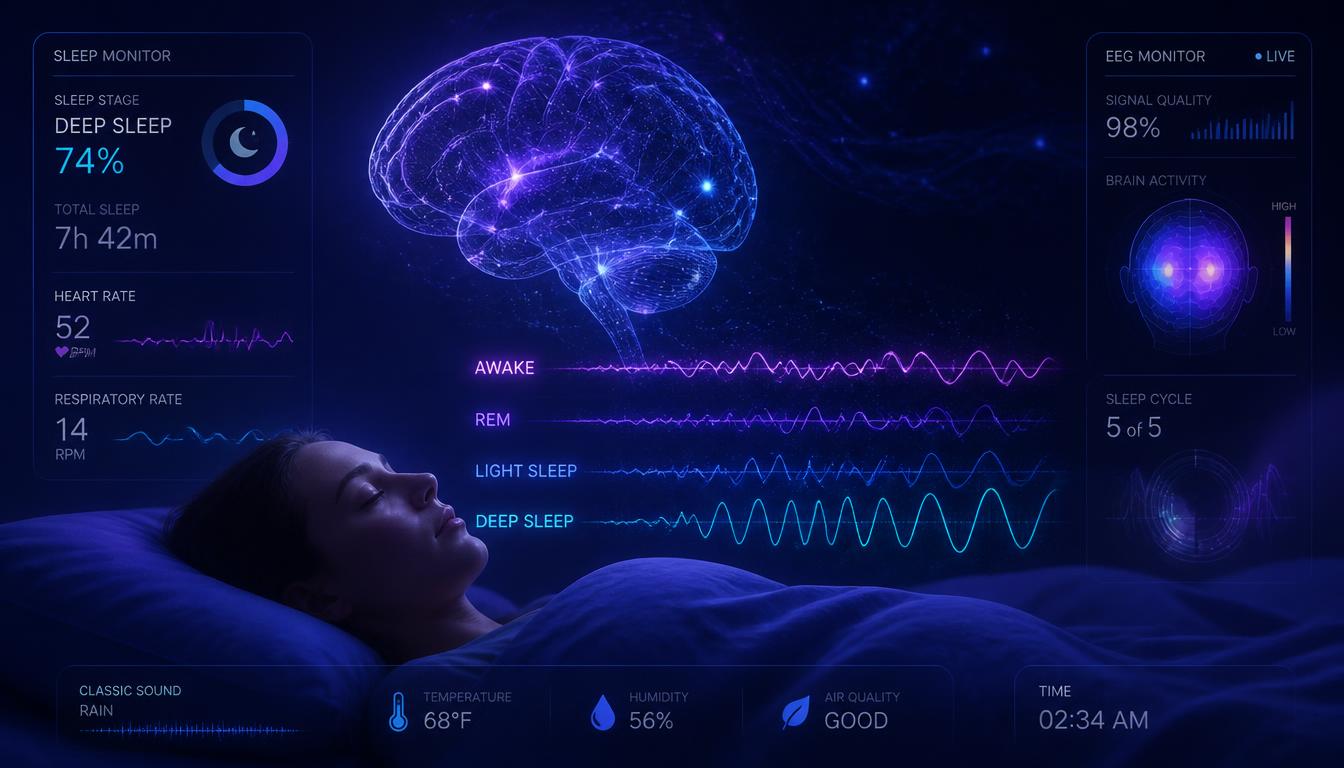
Sleep medicine is a specialized field with unique documentation, diagnostic testing, and chronic disease management requirements that general EMR systems cannot adequately support. A purpose-built Sleep Medicine EMR handles the complete workflow from initial sleep complaint through polysomnography interpretation, CPAP titration, and long-term compliance monitoring, enabling sleep centers to deliver high-quality, efficient care to the 70 million Americans and hundreds of millions worldwide affected by sleep disorders.
Sleep Study Documentation
Polysomnography (PSG) Reports
Polysomnography reports document overnight sleep studies with standardized scoring (AASM 2023 scoring rules): sleep architecture percentages (N1, N2, N3, REM), sleep efficiency, arousal index, respiratory event index (AHI, RDI), oxygen saturation nadir, periodic limb movement index, and cardiac rhythm findings. Structured PSG report templates ensure complete AASM-compliant documentation with automated staging summaries calculated from uploaded scoring data.
Multiple Sleep Latency Test (MSLT)
MSLT documentation captures each nap opportunity: lights out time, sleep onset latency, and presence/absence of REM sleep onset. Mean sleep latency and SOREMP count calculations are automated. MSLT reports integrate with PSG data for comprehensive narcolepsy and hypersomnia workup documentation.
Maintenance of Wakefulness Test (MWT)
MWT trials document wakefulness maintenance ability for occupational safety assessments (commercial drivers, pilots, heavy equipment operators). Mean sleep latency with standard interpretation thresholds is automated. MWT reports support fitness-for-duty evaluations with occupationally relevant clinical language.
CPAP and PAP Therapy Management
CPAP compliance monitoring integrates directly with major PAP device manufacturers (ResMed AirView, Philips DreamMapper, Fisher & Paykel SleepStyle) to import adherence data: hours of use, mask leak, AHI on therapy, and pressure statistics. Compliance summary reports for insurance requirements (Medicare 90-day compliance period) are generated automatically. Clinical decision support flags non-compliant patients for intervention before therapy is discontinued by payers.
Sleep Disorder Registry
Structured disease registries track patient populations by sleep disorder diagnosis: Obstructive Sleep Apnea (OSA) by severity (AHI) and therapy status; Central Sleep Apnea (CSA) including cardiac, opioid-induced, and idiopathic subtypes; Narcolepsy types 1 and 2; Restless Legs Syndrome (RLS) severity tracking; Insomnia with CBT-I treatment tracking; and Circadian Rhythm Disorders. Population dashboards enable quality metric reporting and research cohort identification.
Sleep Questionnaire Integration
Validated sleep assessment tools integrate directly into the clinical workflow: Epworth Sleepiness Scale (ESS), STOP-BANG for OSA screening, Pittsburgh Sleep Quality Index (PSQI), Insomnia Severity Index (ISI), Berlin Questionnaire, and Restless Legs Syndrome Rating Scale. Patient-completed questionnaires via tablet or patient portal automatically populate clinical scores in the EMR for trend tracking over time.
Wearable Device Integration
Consumer-grade sleep trackers (Fitbit, Apple Watch, Oura Ring) and clinical-grade actigraphy devices provide objective sleep data between in-lab studies. Integration with actigraphy platforms (Actiwatch, ActiGraph) imports sleep-wake data for insomnia and circadian disorder management. AI-assisted analysis identifies actigraphy patterns consistent with specific sleep disorders to guide clinical decision-making.
Billing for Sleep Medicine Services
Sleep medicine billing involves complex CPT codes: PSG (95810, 95811), MSLT (95805), CPAP titration (95811), and out-of-center sleep testing (OCST: 95800-95801). HCPCS codes for durable medical equipment (CPAP, BiPAP machines) require separate billing pathways. Automated charge capture from completed study documentation eliminates manual billing entry and reduces coding errors.
Ready to optimize your Sleep Medicine Emr Polysomnography Cpap workflows? Book a tailored Quecorex demo today.
Measuring Therapy Adherence
Positive airway pressure therapy only works if patients use it. Devices report hours of use, leaks, and residual events, and many payers set adherence thresholds. In some payer rules, for example, adherence is defined as use for at least four hours per night on at least 70 percent of nights in a 30-day period, though requirements vary, so check your payers. Software that imports device data, shows trends, and flags patients who are struggling lets clinics intervene early with mask fitting, education, or follow-up.
Sleep Study Workflow Checklist
- Referral and questionnaires captured before the visit.
- Study scheduled with room and equipment availability.
- Recording data and scoring linked to the patient record, with the technologist's notes.
- Report generated with standard indices such as the apnoea-hypopnoea index and oxygen desaturation measures.
- Treatment plan, device order, and follow-up scheduled.
- Adherence downloads reviewed at set intervals.
Billing Considerations
Sleep services involve study fees, professional interpretation, device supply, and follow-up. Payers often require documentation of the diagnosis, the study, and adherence. Ask vendors how these documents are assembled and attached to claims. Estimate the specialty module in the pricing estimator and compare vendors with the selection scorecard.
Running a Sleep Service
Sleep services combine outpatient clinics, diagnostic studies, and long-term therapy management. Patients are often referred from primary care with snoring, daytime sleepiness, or suspected apnoea. Home sleep tests suit many patients, while in-laboratory polysomnography is used for complex cases. Managing the service means balancing waiting lists for studies, technologist time, scoring workload, and follow-up. Software should show referral queues, study schedules, results awaiting scoring or interpretation, and patients due for therapy review.
Home Testing and In-Lab Studies
| Study type | Suits | Software needs |
|---|---|---|
| Home sleep apnoea test | Patients with a high pre-test probability of obstructive sleep apnoea and few other conditions | Device loan tracking, data upload, scoring queue |
| In-laboratory polysomnography | Complex cases, suspected other sleep disorders, or unsuccessful home tests | Room scheduling, technologist notes, full study data storage |
| Titration study | Setting pressure for therapy in selected patients | Link to device prescription and follow-up |
Keeping Patients on Therapy
- Check adherence early, often within the first weeks, when most problems appear.
- Address mask fit, dryness, pressure discomfort, and confusion quickly.
- Use reminders and simple self-service resources.
- Review data at set intervals and record decisions in the chart.
- Coordinate with primary care and specialists, such as cardiology, when sleep apnoea affects other conditions. See cardiology EMR software.
- Use small-practice tools for booking and billing. See clinic management software.
Billing rules for sleep services depend on your payers, so see insurance claims management for how to prevent denials.
Final Thoughts
Sleep centers deserve purpose-built software that understands their unique workflows, from sleep study scheduling through CPAP compliance management and long-term disorder tracking. Quecorex Sleep Medicine module is fully integrated with the hospital EMR, enabling seamless coordination with pulmonology, cardiology, neurology, and primary care for comprehensive patient management.