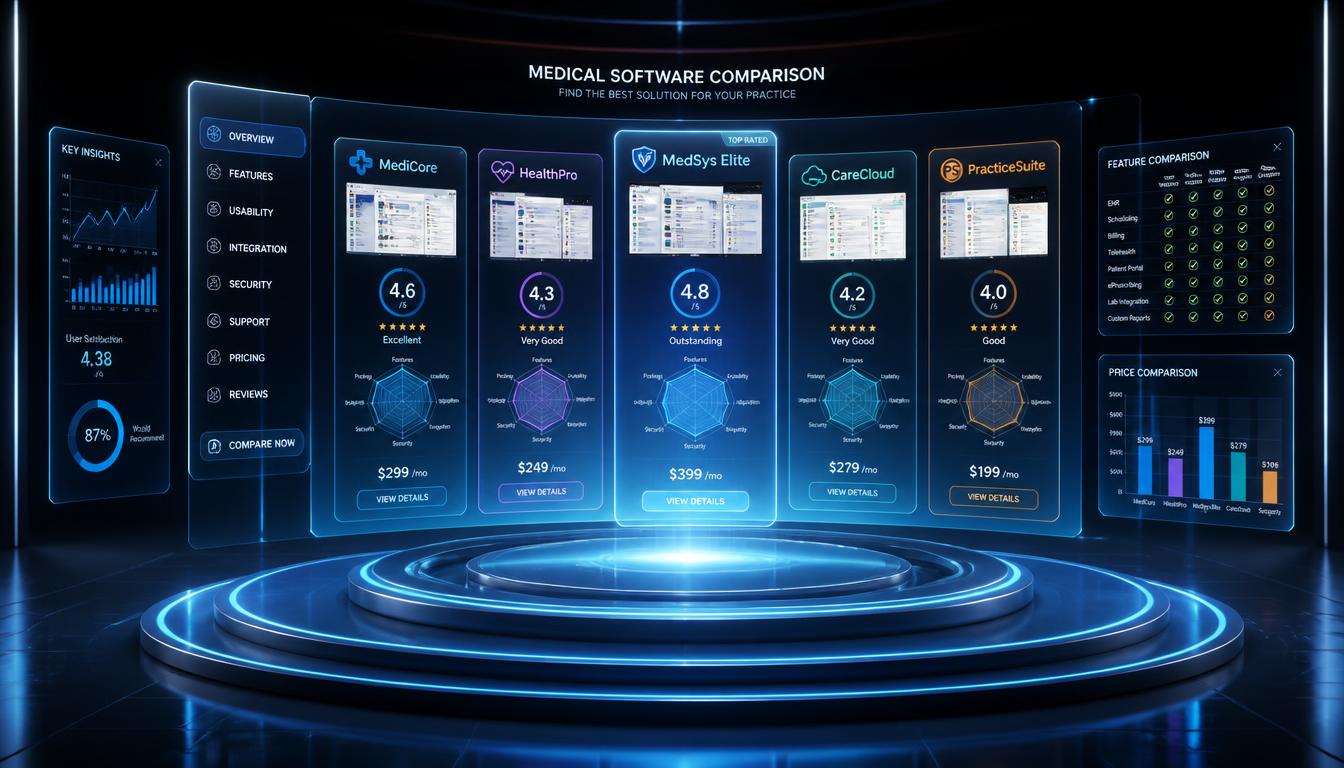
Choosing a Hospital Management System is one of the most consequential technology decisions a healthcare organization can make. The market is crowded, pricing is opaque, implementation is complex, and the wrong choice can be costly to undo. This guide cuts through vendor marketing to help hospital administrators, CIOs, and healthcare IT leaders make informed, evidence-based decisions.
What to Evaluate in an HMS
Before comparing systems, establish your evaluation criteria: functional completeness (does it cover your workflows?), compliance capability (does it meet your country's regulatory requirements?), integration architecture (HL7 FHIR R4, legacy HL7 v2?), deployment model (cloud/on-premise/hybrid?), implementation support, total cost of ownership, and vendor stability (will they be around in 10 years?).
The Major HMS Platforms
Epic Systems
Best for: Large US academic medical centers and health systems. Epic dominates the US inpatient EMR market with approximately 33% market share. Strengths include comprehensive functionality, strong interoperability, and a large user community. Limitations include very high cost ($100M+ for large implementations), US-centric design, complex implementation requiring Epic-certified consultants, and limited support for non-English markets. Not well-suited for international deployment or resource-constrained healthcare systems.
Oracle Health (Cerner)
Best for: Large US and international health systems seeking a viable Epic alternative. Following Oracle's 2022 acquisition, Cerner is undergoing significant product transformation. Millennium (the core platform) has strong clinical functionality and broader international presence than Epic. Implementation complexity and cost are comparable to Epic. The acquisition-driven product strategy changes create some uncertainty for long-term planning.
Meditech
Best for: Mid-size community hospitals in the USA and Canada. Meditech Expanse has made significant cloud-native improvements and competitive pricing makes it attractive for hospitals that cannot afford Epic implementations. Strong in community hospital market but limited specialty depth compared to Epic/Cerner in academic settings.
Allscripts (Veradigm)
Best for: Ambulatory and physician practice settings. Allscripts has strong outpatient workflows but has lost significant inpatient market share. The company has undergone multiple rebranding cycles that create customer uncertainty. Integration capabilities are solid for ambulatory-to-specialty coordination.
MEDITECH Expanse
The cloud-native evolution of Meditech's platform has gained momentum in community hospitals seeking modern architecture without Epic-level pricing. Strong for 100–400 bed community hospitals with standard specialty mix.
OpenMRS (Open Source)
Best for: Low-resource settings, NGO-funded hospitals, and developing country deployments. OpenMRS is free and open-source with strong global community support. Limitations include limited out-of-box functionality (requires significant customization), no commercial support guarantee, and technical implementation requiring developer resources. Best suited for organizations with strong technical capacity and constrained budgets.
iCliniq / Practo
Best for: Small to mid-size clinic chains in South and Southeast Asia. Practo offers accessible cloud-based clinic management with appointment scheduling, basic EMR, and telemedicine. Not suitable for complex hospital operations or multi-specialty academic environments.
Quecorex
Best for: Global hospitals and clinic networks seeking comprehensive functionality at competitive pricing, particularly in Africa, Middle East, South/Southeast Asia, and Latin America. Quecorex delivers 100+ hospital modules, full pharmacy management, 16 AI clinical tools, and compliance support for 150+ countries. Cloud-native architecture enables rapid deployment without the infrastructure burden of legacy systems. Designed from the ground up for global markets rather than retrofitted from US-centric platforms.
HMS Pricing Guide
HMS pricing is rarely published openly. General ranges: Epic implementations range from $15M for small systems to $150M+ for large IDNs. Cerner/Oracle similar range. Meditech is typically 40-60% of Epic cost for comparable implementations. Cloud-based alternatives like Quecorex are subscription-based with significantly lower upfront investment, making enterprise-grade HMS accessible to hospitals that cannot justify nine-figure capital expenditures.
The Right Choice for International Hospitals
The Epic/Cerner duopoly is designed for and optimized for the US healthcare market, HIPAA compliance, US insurance billing, English-language workflows, and US clinical standards. Hospitals in Kenya, UAE, Philippines, Brazil, or India need a system designed for their regulatory environment, language, payer mix, and clinical workflows. US-centric platforms require expensive customization to serve international markets that global-first platforms handle natively.
Ready to optimize your Top 10 Hospital Management Systems Compa workflows? Book a tailored Quecorex demo today.
The Enterprise Giants vs. Quecorex
When comparing top-tier solutions, legacy systems like Epic and Cerner (Oracle Health) dominate the enterprise space. Epic implementations often exceed $100M+ for large health systems, requiring multi-year rollouts and massive internal IT teams for ongoing maintenance. Cerner offers slightly more flexibility but still carries a significant total cost of ownership (TCO).
Why Quecorex? Quecorex fills the exact gap left by these giants: it offers 95% of the enterprise-grade functionality (including full FHIR interoperability and AI clinical modules) at a fraction of the deployment cost. Unlike legacy vendors that require rigid workflow adaptation, Quecorex's cloud-native architecture allows mid-sized hospitals to deploy within weeks, not years, without needing a massive onsite IT team.
Conclusion
The right HMS depends on your size, geography, budget, and strategic priorities. Large US health systems have limited options outside Epic/Cerner. International hospitals, mid-size facilities, and resource-constrained systems have excellent alternatives that deliver comprehensive functionality without the cost and complexity of legacy enterprise platforms.
Related Guides
- Epic alternatives for mid-size hospitals and clinics
- Oracle Health (Cerner) alternatives: what to compare
- MEDITECH alternatives for community and regional hospitals
- What a hospital management system really costs over three years