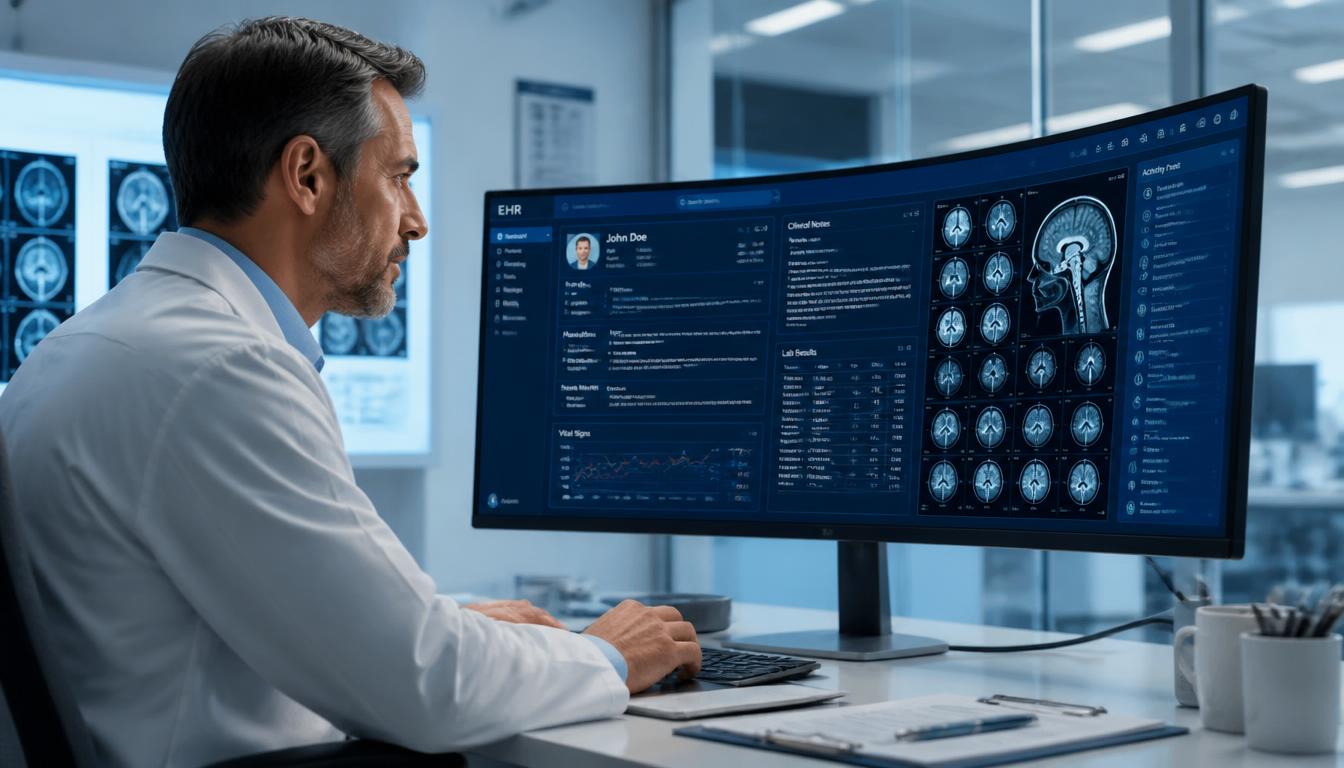
Electronic Health Records (EHR) software has transformed from a luxury for large hospitals into essential infrastructure for healthcare providers of every size. Electronic Health Records software digitizes patient charts, clinical documentation, orders, results, and care coordination into unified digital platforms accessible anywhere, anytime. With EHR adoption exceeding 95% among US hospitals and 85% among physicians, choosing the right system is one of the most consequential decisions healthcare organizations make.
What Is Electronic Health Records Software?
Electronic Health Records software, commonly called EHR software or EHR systems, is a digital platform that maintains comprehensive patient health information across encounters, providers, and care settings. Unlike paper charts limited to a single location, EHRs provide real-time access to complete patient histories: diagnoses, medications, allergies, lab results, radiology images, clinical notes, and care plans, enabling coordinated, evidence-based care delivery.
EHR vs EMR: Understanding the Difference
While often used interchangeably, EMR (Electronic Medical Record) and EHR (Electronic Health Record) have technical distinctions. EMRs are digital versions of paper charts within a single practice or hospital, they contain clinical data but are not designed to be shared outside that organization. EHRs are built for interoperability, designed to share patient information across organizations, healthcare systems, and geographic regions. Modern systems blur this distinction; most "EMRs" today have EHR-level interoperability capabilities.
Core Features of Electronic Health Records Software
1. Clinical Documentation
Structured templates for history and physical examinations, progress notes, procedure notes, discharge summaries, and specialty-specific documentation (cardiology, oncology, pediatrics). SOAP note formats, problem-oriented charting, and voice dictation integration reduce documentation time while maintaining clinical detail. Structured data capture enables downstream analytics impossible with free-text documentation.
2. Computerized Physician Order Entry (CPOE)
Digital ordering for medications, lab tests, radiology studies, consultations, and procedures directly from the EHR eliminates handwriting errors and transcription delays. CPOE with clinical decision support alerts for drug interactions, duplicate orders, and contraindicated therapies has been shown to reduce medication errors by 50-80% in multiple studies.
3. E-Prescribing
Electronic prescribing transmits prescriptions directly to pharmacies, eliminating illegible handwriting and enabling real-time formulary checking, prior authorization workflows, and controlled substance tracking (EPCS). Patients receive prescriptions faster, and pharmacists can clarify questions with prescribers electronically without phone tag.
4. Clinical Decision Support
Evidence-based clinical protocols, drug-allergy checking, renal dosing adjustments, preventive care reminders (cancer screenings, immunizations), and sepsis early warning systems provide real-time clinical guidance at the point of care. Modern AI-powered clinical decision support learns from outcomes data to continuously improve recommendations.
5. Results Review and Management
Lab results, radiology reports, pathology findings, and consultant recommendations flow directly into the EHR with automated critical value alerts routing urgent results to treating clinicians within minutes. Result trending and longitudinal graphs help clinicians identify patterns across serial measurements (HbA1c progression, GFR decline, blood pressure control).
6. Care Coordination and Referrals
Electronic referral management tracks specialist referrals from placement through completion with visibility into appointment status, consultant recommendations, and pending diagnostic tests. Care team messaging enables secure communication between providers without phone calls or paging interruptions. Care plans document goals and interventions across multidisciplinary teams.
7. Patient Portal
Secure patient access to visit summaries, lab results, medication lists, immunization records, and appointment scheduling empowers patients as active participants in their care. Secure messaging enables patients to ask questions and request prescription refills without phone calls. Patient portal use correlates with improved medication adherence and better chronic disease control.
Interoperability and Data Exchange
The value of EHR data multiplies when it can be shared across organizations. HL7 FHIR (Fast Healthcare Interoperability Resources) has emerged as the global standard for EHR data exchange, enabling structured patient data to flow seamlessly between hospitals, clinics, labs, pharmacies, and public health agencies. FHIR-based interoperability supports care transitions, specialist referrals, population health initiatives, and national health information exchanges.
Meaningful Use and Incentive Programs
In the USA, the Meaningful Use program (now evolved into Promoting Interoperability under MIPS/MACRA) provided financial incentives for EHR adoption and use meeting specific criteria: CPOE usage thresholds, clinical decision support deployment, e-prescribing rates, health information exchange participation, and patient portal activation rates. These programs accelerated EHR adoption from 10% to over 95% among hospitals in less than a decade.
How to Choose Electronic Health Records Software
Assess Your Organization's Needs
Small practices prioritize ease of use, affordability, and quick implementation (cloud-based systems). Large hospital systems need comprehensive functionality, specialty module depth, complex integration capabilities, and enterprise-grade security. Specialty practices require clinical templates tailored to their workflows (cardiology echo reporting, oncology chemotherapy protocols, orthopedic operative notes).
Evaluate Vendor Credentials
Look for EHR systems certified by recognized bodies: ONC Certification (USA), NHS Digital approval (UK), CE marking (Europe). Vendor financial stability, customer retention rates, and implementation success rates predict long-term partnership viability. Review customer references from organizations similar to yours in size, specialty, and geography.
Implementation and Training
EHR implementation typically requires 6-18 months from contract signing to full go-live, depending on organization size and complexity. Comprehensive training for all users, physician champions leading peer adoption, super-user support networks, and 24/7 technical support during go-live are critical success factors. Under-investment in training is the most common cause of implementation failure.
Total Cost of Ownership
EHR costs include: software licensing (perpetual license or subscription), implementation services, interface development, hardware infrastructure (servers, workstations, mobile devices), ongoing support and maintenance, and upgrade costs. Cloud-based EHR systems shift infrastructure costs to subscription models with lower upfront investment but ongoing monthly fees. Calculate total cost of ownership over 5-10 years for accurate comparison.
Global Compliance Standards
EHR systems must comply with jurisdiction-specific regulations: HIPAA (USA) mandates encryption, access controls, audit logs, and breach notification. GDPR (EU) requires patient consent management, data portability, and right to erasure. PIPEDA (Canada) governs personal health information protection. Global EHR platforms adapt their security and compliance frameworks to each deployment region automatically.
Need help navigating compliance requirements? Schedule a consultation with our regulatory specialists.
Cloud vs On-Premise EHR Systems
Cloud-based EHR systems offer lower upfront costs, automatic updates, remote access from any device, and no server maintenance burden, ideal for small to mid-size practices and multi-site organizations. On-premise EHR deployments provide maximum data control and customization, preferred by large hospitals with robust IT departments and regulatory requirements for local data storage. Hybrid models combine cloud management with local data storage for organizations balancing accessibility with data sovereignty requirements.
Benefits of Electronic Health Records Software
Organizations implementing comprehensive EHR systems report: 30-50% reduction in medical errors, 25-35% decrease in duplicate testing, 20-40% improvement in coding accuracy and revenue capture, 15-20% gains in clinician productivity after the learning curve, and 25-35% improvement in patient satisfaction scores. Quality metrics (HEDIS, CMS quality measures) improve 15-25% as EHRs enable systematic preventive care tracking and chronic disease management.
Ready to transform your clinical operations? Book a tailored Quecorex EHR demo today.
Future of Electronic Health Records
The next generation of EHR systems integrates artificial intelligence for ambient clinical documentation (physicians talk naturally with patients while AI generates structured notes), predictive analytics identifying high-risk patients before adverse events occur, and genomic data integration enabling precision medicine at scale. Blockchain-based health information exchanges promise patient-controlled health data sharing across organizational boundaries. The EHR is evolving from passive documentation tool to active clinical intelligence system.
Final Thoughts
Electronic Health Records software is no longer optional, it is the foundation of modern healthcare delivery. Whether you are a solo practitioner implementing your first EHR or a hospital system optimizing a complex enterprise deployment, the right system transforms clinical efficiency, patient safety, and care quality. Quecorex delivers a complete, globally-compliant EHR platform designed for healthcare providers across 150+ countries, from primary care clinics to 500-bed academic medical centers.