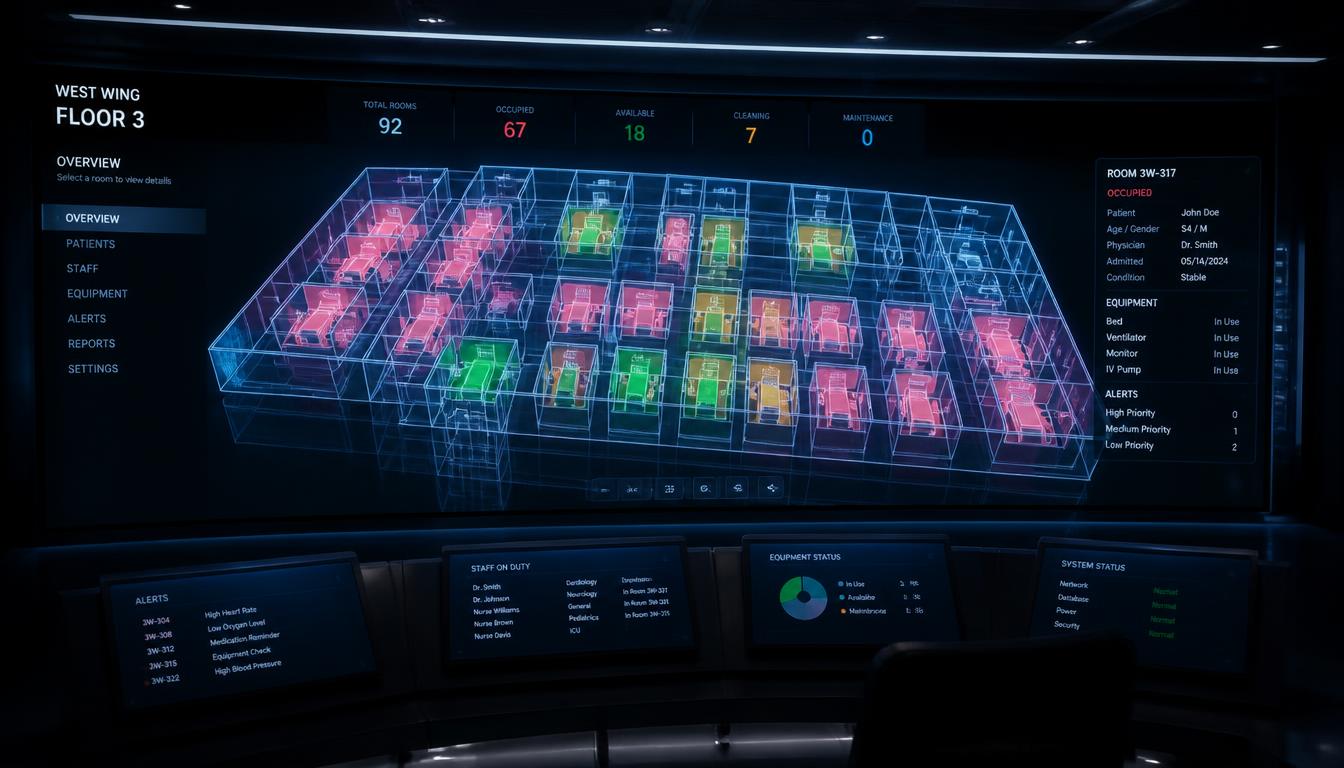
Hospital bed management is one of the most operationally complex challenges in healthcare, balancing patient demand that fluctuates by hour, day, and season against fixed bed supply across dozens of units, while maintaining safety margins for emergency capacity. A hospital bed management system provides real-time visibility into bed status across the entire facility, enabling operational leaders to optimize patient flow, reduce ED boarding, and maximize the productive use of every bed.
Real-Time Bed Board
The hospital-wide bed board displays every bed in every unit with current status: occupied (patient name, admission diagnosis, attending physician, expected discharge date), dirty (awaiting housekeeping), in-progress cleaning, and available. Color-coded status indicators provide instant situational awareness. Bed request queues from the ED and surgical suites show pending demand against available supply, enabling proactive bed assignment rather than reactive scrambling.
Predictive Discharge Planning
AI-powered discharge prediction identifies patients likely to discharge within the next 4-24 hours based on clinical indicators, physician documentation, and historical patterns. Predicted discharge lists help capacity managers anticipate bed availability and pre-position housekeeping resources. Early morning predicted discharge reports enable targeted multi-disciplinary rounds focused on removing barriers to discharge for identified patients.
Housekeeping Integration
When a patient discharges, the bed management system automatically generates a housekeeping work order. Housekeeping staff receive mobile notifications with the room number, cleaning type required (standard discharge vs. isolation terminal clean), and priority. Real-time status updates as cleaning progresses (in-progress → complete) instantly reflect in the bed board, enabling patient placement as soon as the room is ready rather than requiring manual communication between nursing and housekeeping teams.
Isolation and Infection Control Coordination
Contact, droplet, and airborne isolation requirements are displayed on the bed board alongside bed status. Isolation room inventory, negative pressure rooms, positive pressure rooms, standard private rooms, is tracked separately. Cohort placement (grouping patients with the same infection organism) is facilitated by visual cohorting tools. Infection control policy alerts notify nursing when new isolation orders are placed on patients not yet in appropriate rooms.
Surge Capacity Management
During surge events (influenza season, disaster incidents, community outbreaks), hospitals must rapidly expand capacity beyond normal operating parameters. Bed management systems support surge planning by identifying: beds that can be activated quickly (recovery room, PACU, procedural areas), units that can cohort additional patients, and discharge candidates who can accelerate throughput. Surge activation workflows notify department heads and activate additional staffing plans.
Analytics and Performance Metrics
Bed utilization reports track occupancy by unit, bed type, and time period. Average length of stay by DRG identifies high-LOS outliers for case management intervention. Boarding hours (time patients spend in ED awaiting inpatient beds) trend over time and by unit destination. Housekeeping turnaround time analysis identifies which cleaning assignments are creating placement delays. These analytics guide operational improvement initiatives with objective data.
Ready to optimize your Hospital Bed Management System Optimizin workflows? Book a tailored Quecorex demo today.
Occupancy Is Not the Same as Flow
High occupancy looks efficient, but many hospitals find that when occupancy stays very high, delays rise because there is no spare capacity to absorb variation in arrivals. Measure flow as well: time from decision to admit to bed assigned, time from discharge order to patient leaving, and the number of patients waiting in emergency or recovery for a bed. A bed management system helps by showing the current picture and the expected picture for the next hours.
Discharge Planning Habits
- Set an expected discharge date at admission and review it daily.
- Prepare medicines, documents, and transport the day before.
- Hold a short daily huddle to identify patients ready to go and barriers to discharge.
- Notify housekeeping the moment a discharge is confirmed.
- Track discharges before noon as a flow indicator.
Metrics for a Bed Board
| Metric | Why it matters |
|---|---|
| Occupancy by ward and by hour | Shows pressure points and daily patterns |
| Average length of stay by service | Highlights delays and variation |
| Bed turnaround time | How quickly a bed is cleaned and ready |
| Boarding time in emergency | Patients waiting for an inpatient bed |
| Blocked beds and reasons | Beds unavailable for maintenance or isolation |
See how outpatient flow connects in our guide to emergency department software, and check module costs in the pricing estimator.
Who Does What in Bed Management
| Role | Task | What the system should give them |
|---|---|---|
| Bed manager or site coordinator | Match demand to capacity across the hospital | A live board of beds, pending admissions, and expected discharges |
| Ward nurse in charge | Prepare for admissions and discharges on the ward | Ward view with patient status and discharge readiness |
| Emergency team | Know when an inpatient bed will be ready | Bed requests with status and estimated times |
| Housekeeping | Clean beds fast after discharge | Task list triggered by discharge, with priority for urgent beds |
| Doctors | Decide and document discharge | Discharge planning prompts and simple orders |
Typical Causes of Delayed Discharge
- Waiting for a doctor to review or sign the discharge.
- Waiting for medicines from pharmacy.
- Waiting for transport or a family member.
- Waiting for a test result or scan.
- Waiting for placement in another facility or social arrangements.
- Waiting for billing or insurance clearance.
Record the reason for each delay in the system. After a month, the most common reasons tell you where to focus. In many hospitals, clearing insurance and billing earlier in the stay, rather than at the end, removes a surprising amount of delay. See our insurance claims guide for how pre-authorisation fits in.
Connecting Beds to the Front Door
Bed pressure is felt first in the emergency department and outpatient clinics. When the bed board is shared with those teams, they can anticipate admissions, plan transfers, and avoid sending patients to wards that cannot take them. Learn how flow appears in the outpatient setting in our queue management guide, and how nurses record the ward side in nursing management software.
Next Steps
Effective bed management transforms hospital patient flow from a constant firefight into a proactive, data-driven operation. Quecorex Bed Management integrates with the ED, inpatient EMR, surgical scheduling, and housekeeping management to provide complete bed lifecycle visibility from request to discharge for hospitals of any size.