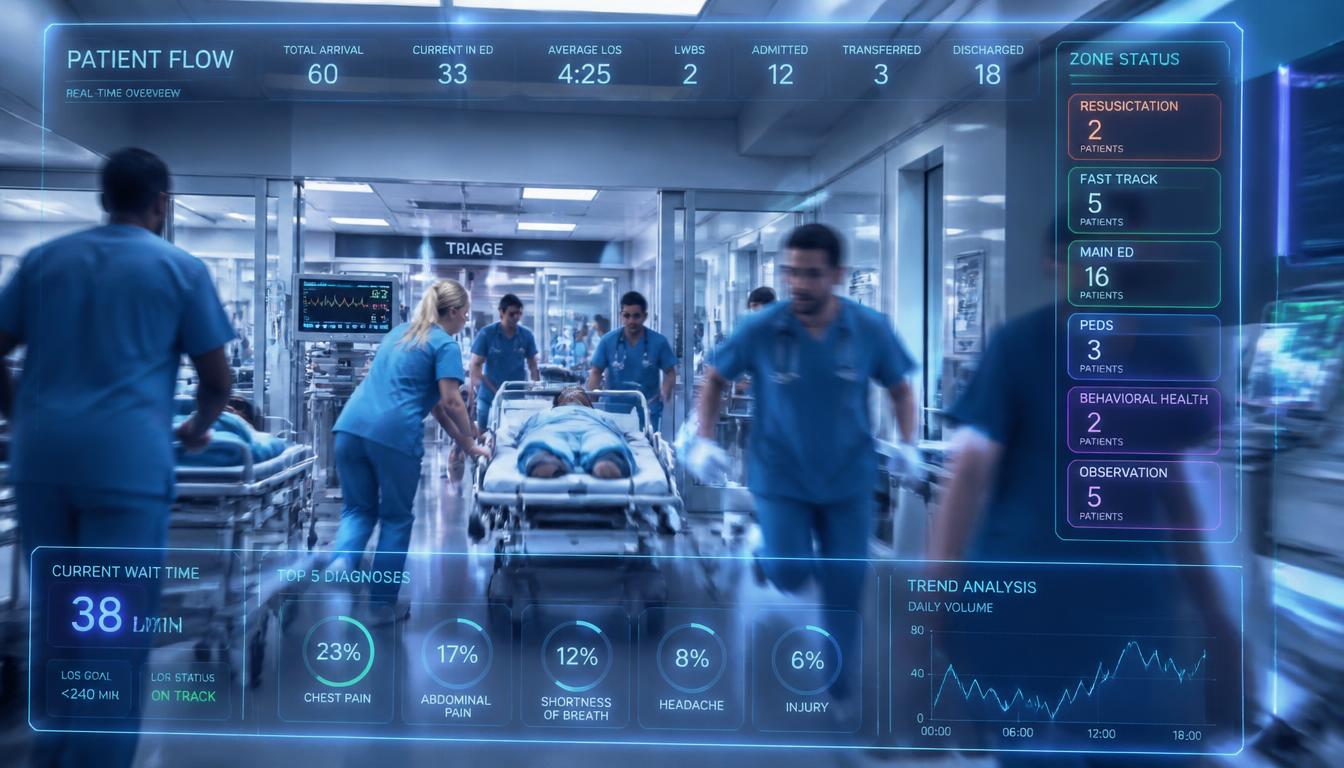
Emergency Departments operate at the intersection of clinical urgency and operational complexity. With annual ED visits exceeding 130 million in the USA alone and similar pressures worldwide, the difference between effective and ineffective ED software can literally save lives. Door-to-doctor time, left-without-being-seen (LWBS) rates, and ED boarding all respond dramatically to well-implemented software solutions.
Core Features of Emergency Department Software
ESI Triage System
The Emergency Severity Index (ESI) 5-level triage system assigns acuity scores from 1 (immediate life threat) to 5 (non-urgent). ED software guides triage nurses through standardized assessment, auto-calculates ESI scores, and immediately assigns patients to appropriate care zones. Real-time triage data feeds the patient tracking board visible to all ED staff simultaneously.
Real-Time Patient Tracking Board
The ED tracking board is the operational heartbeat of the emergency department, showing every patient's location, acuity, attending provider, length of stay, pending orders, and next action. Color-coded status indicators alert staff to patients approaching wait time thresholds. Physicians see pending results; nurses see medication administration tasks; charge nurses see boarding patients needing inpatient beds.
STEMI and Stroke Protocols
Time-to-treatment is the most critical quality metric for STEMI and stroke. ED software triggers protocol checklists immediately when EKG findings or clinical presentation meets criteria, alerting the cath lab team, stroke neurology, and pharmacy simultaneously. Door-to-balloon time tracking for STEMI and door-to-needle time for stroke are automatically calculated and reported to quality programs.
Trauma Documentation
Trauma activations require simultaneous multi-team documentation of rapid assessments, interventions, blood products, medications, and vital sign trends. Trauma flowsheets capture time-stamped events across the entire resuscitation team. Trauma registry export meets state and national trauma registry reporting requirements.
ED Bed Management and Boarding
Real-time bed requests, discharge notifications from inpatient units, and housekeeping status updates feed into an integrated bed management view. Predictive algorithms forecast inpatient bed availability 4–6 hours ahead, allowing ED leadership to proactively redirect patient flow and reduce boarding. Hospitals reducing ED boarding time by 60 minutes cut overall ED length of stay by 15–20%.
Clinical Decision Support in the ED
Sepsis screening algorithms run continuously against vital signs, lab results, and clinical documentation, alerting physicians when Systemic Inflammatory Response Syndrome (SIRS) criteria or NEWS2 scores suggest early sepsis. Sepsis bundle compliance improves mortality by 20–30% when electronic prompts guide timely fluid administration, blood cultures, and antibiotic ordering.
ED Quality Metrics and Reporting
Door-to-triage time (target: <10 minutes), door-to-provider time (target: <30 minutes), LWBS rate (target: <2%), median length of stay (target: <3 hours for discharged patients), and ED boarding hours are all automatically calculated and reported to CMS, Joint Commission, and state health departments from your ED software data.
Need help with ED quality reporting? Schedule a consultation to discuss automated compliance reporting.
Pediatric ED Considerations
Pediatric EDs require weight-based dosing calculators (Broselow tape integration), age-specific vital sign normal ranges, pediatric triage modifications, and specialized documentation templates for child abuse screening and pediatric trauma. Separate pediatric and adult tracking boards prevent inappropriate mixing of pediatric and adult patients in high-volume EDs.
Integration with Hospital Systems
ED software integrates with the hospital EMR for complete patient history access, lab and radiology for real-time results, pharmacy for medication ordering and dispensing, bed management for admission requests, and ambulance services for pre-arrival patient information via ePCR data feeds.
Ready to reduce ED wait times and improve patient flow? Book a tailored Quecorex ED demo.
Triage Systems the Software Should Support
| Region | Common triage scale |
|---|---|
| United States | Emergency Severity Index |
| United Kingdom | Manchester Triage System |
| Australia and New Zealand | Australasian Triage Scale |
| Canada | Canadian Triage and Acuity Scale |
Whichever scale you use, the software should record the triage category, time stamps, and any re-triage, and drive the order in which patients are seen.
Flow Metrics to Watch
- Door to triage and door to doctor times.
- Length of stay in the department, split by admitted and discharged patients.
- Left without being seen rate.
- Boarding time for admitted patients waiting for a bed.
- Time to key tests and results such as ECG, laboratory, and imaging.
- Return visits within a short window.
Practical Changes That Cut Waits
- Start assessment and tests at triage using standing orders.
- Separate low-acuity patients into a fast track.
- Link the department to the bed board so admissions are anticipated.
- Show a live board of all patients and their status to every clinician.
- Review the busiest hours weekly and adjust staffing.
See bed management for the inpatient side, and price an emergency module in the pricing estimator.
The Emergency Journey Step by Step
- Arrival and registration. Quick minimum data capture, with full details completed later.
- Triage. Assign a category, record vital signs, and start immediate tests if protocols allow.
- Assessment and treatment. Clinician review, orders, procedures, and reassessment.
- Diagnostics. Laboratory and imaging requests with tracking of results.
- Decision. Admit, discharge, transfer, or observe.
- Departure. Discharge instructions and prescriptions, or handover to a ward.
The software should show every patient's place in this journey on a single board, with colour or icons for time in department, waiting results, and pending decisions.
Handling Surges and Mass Casualty Events
- Rapid registration with temporary identifiers and later merging with full records.
- Batch triage tools and tags that link to the record.
- Clear display of capacity and resources, including beds, staff, and theatre availability.
- Communication tools to notify the wider hospital and on-call staff.
- Downtime forms for use if systems fail during an emergency.
After the Emergency Department
Emergency waiting is often driven by what happens elsewhere in the hospital. When wards are full or discharges are late, admitted patients wait in the department. Sharing a bed board and tracking outpatient flow helps. See our guides to bed management, queue management, and hospital dashboards for the system-wide view.
Conclusion
Emergency Department software is clinical infrastructure, not just an administrative tool. The right system turns chaotic, high-acuity environments into organized, protocol-driven operations where every minute of delay is tracked, every protocol is supported, and every patient receives timely, safe care. Quecorex ED module serves emergency departments from 20-bed rural hospitals to 100,000-visit academic medical centers.