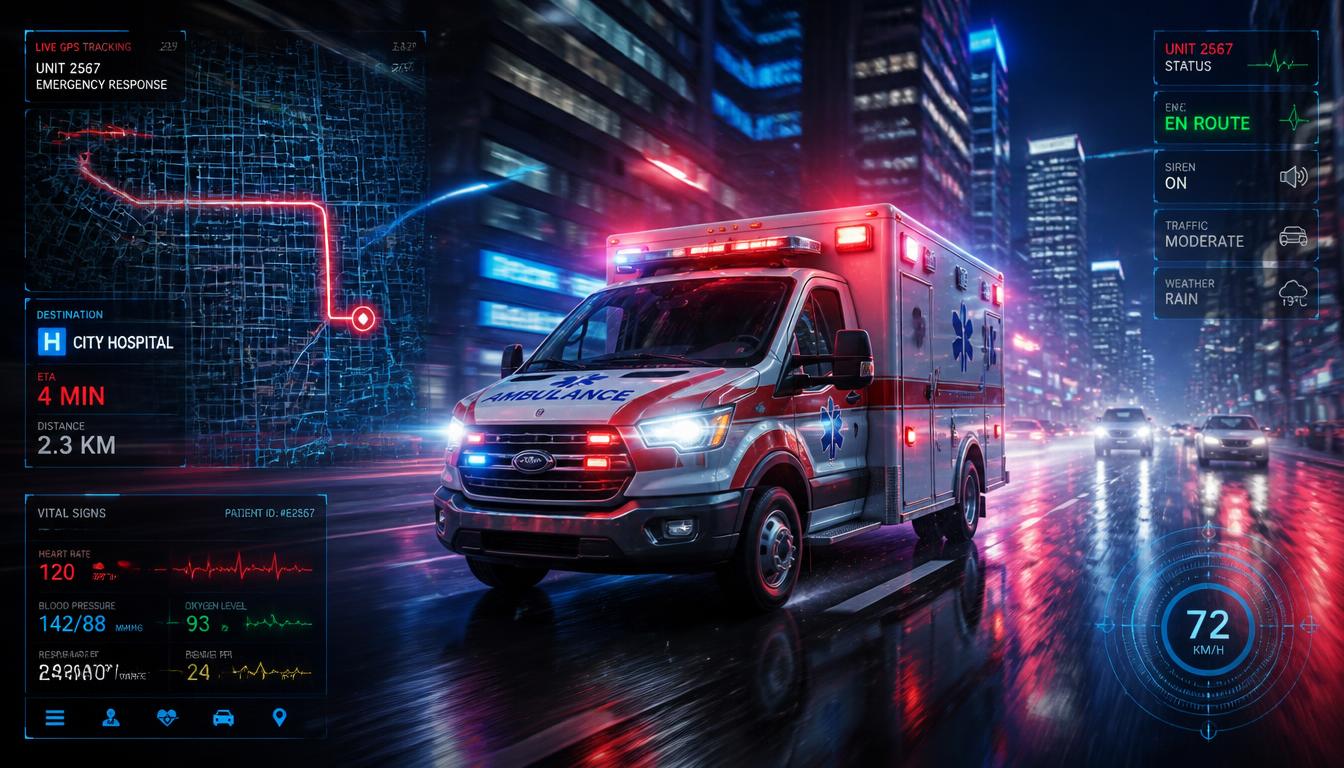
Every minute in emergency medical services can be the difference between life and death. A modern Ambulance Management System with real-time GPS tracking, intelligent dispatch algorithms, and seamless hospital handoff transforms EMS operations from reactive responses to optimized emergency care systems. From fleet tracking to NEMSIS-compliant ePCR documentation, technology is reshaping pre-hospital care globally.
Core Components of an Ambulance Management System
Real-Time GPS Fleet Tracking
Every ambulance, response vehicle, and specialty unit appears on a live map with real-time location, speed, unit status, and crew information. Dispatchers see the nearest available unit to any incident instantly. Geofencing alerts trigger when units enter or leave designated zones. Historical route playback supports quality review and training.
Intelligent Dispatch System
Advanced dispatch algorithms consider unit proximity, vehicle capabilities (ALS vs BLS), crew certifications, current traffic conditions, and hospital destination preference to recommend the optimal unit for each call. Automatic dispatch suggestions reduce dispatcher decision time by 60%, enabling faster response in high-call-volume situations. Priority call queuing ensures life-threatening calls jump the queue automatically.
Electronic Patient Care Reports (ePCR)
ePCR replaces paper run reports with structured digital documentation completed on tablets or ruggedized devices in the ambulance. Crew members document patient demographics, chief complaint, assessment findings, vital signs, treatments provided, medications administered, and transport destination using validated forms that enforce data completeness. ePCR data feeds directly into hospital EMRs at arrival, giving ED teams the complete prehospital picture before the ambulance docks.
NEMSIS Compliance
The National EMS Information System (NEMSIS) 3.x data standard governs ePCR documentation in the USA. NEMSIS-compliant software captures all required data elements for state and national EMS reporting, enabling benchmarking against national EMS quality metrics. Similar reporting frameworks exist in the UK, Canada, Australia, and other countries.
Hospital Integration and Pre-Notification
Real-time ePCR data transmits to the receiving hospital before the ambulance arrives. ED nurses can prepare the appropriate room (trauma bay, cardiac room, general ED bed) and notify appropriate specialists (cardiac team for STEMI, stroke team for suspected CVA) based on prehospital findings. Hospital handoff using SBAR (Situation, Background, Assessment, Recommendation) communication is documented in both the ePCR and hospital EMR simultaneously.
Fleet and Equipment Management
Vehicle maintenance scheduling, equipment certification tracking, medication expiry management, oxygen level monitoring, defibrillator readiness verification, and stretcher inspection logs are managed within the fleet management module. Preventive maintenance alerts ensure no vehicle leaves the station with overdue service or expired equipment.
Inter-Facility Transport Management
Critical care transport between facilities requires special planning, bed confirmation at the receiving facility, specialty transport team coordination, ventilator and IV pump management during transport, and documentation continuity from sending to receiving facility. Inter-facility transport modules coordinate all of these elements with automated communication workflows.
Billing and Reimbursement
Ambulance billing is complex, reimbursement depends on transport level (BLS, ALS 1, ALS 2, SCT), mileage, medical necessity documentation, and payer type (Medicare, Medicaid, private insurance, out-of-pocket). Integrated billing captures all transport data from ePCR automatically, generates claims compliant with Medicare ambulance fee schedule requirements, and tracks reimbursement by payer type.
Quality Improvement and Analytics
Response time analytics (dispatch time, turnout time, travel time), cardiac arrest survival rates, ROSC (Return of Spontaneous Circulation) rates, clinical protocol compliance, and crew performance metrics enable continuous quality improvement. Automated reporting to state EMS agencies and national registries saves administrative hours weekly.
Want better EMS analytics? Request a demo of our real-time ambulance management dashboards.
Global EMS Technology Considerations
EMS technology requirements vary significantly globally. Low-resource settings require offline-capable ePCR that syncs when connectivity returns. Urban systems in dense cities need traffic-aware routing. Rural systems need satellite communication for areas without cellular coverage. A globally-ready AMS adapts to infrastructure constraints while maintaining documentation quality.
Ready to optimize your EMS operations? Book a tailored Quecorex AMS demo.
Response Time Metrics
| Interval | Why it matters |
|---|---|
| Call answered to dispatch | Control room efficiency |
| Dispatch to on-scene | Travel time and positioning |
| On-scene to departure | Time spent treating and packaging the patient |
| Departure to hospital handover | Transport and hospital readiness |
| Handover to available | Turnaround that returns the vehicle to service |
Each interval points to a different fix. Long handover times, for example, are a hospital process problem rather than a dispatch problem.
Fleet and Crew Management
- Vehicle checks and maintenance scheduled and recorded, with vehicles taken out of service when needed.
- Equipment and drug checks at shift start, with restocking logged.
- Crew rosters and qualifications tracked, including expiry of certifications.
- Fuel and mileage monitored to control cost.
- Incident reports for vehicle and clinical events, with follow-up.
Connecting to the Hospital
The best ambulance systems share information with the receiving hospital before arrival: patient condition, vital signs, and estimated arrival. That lets the emergency team prepare and reduces handover time. Read our emergency department software guide for the receiving side, and use the pricing estimator to check the ambulance module cost.
From Emergency Call to Handover: The Data You Need
Every ambulance response generates data that can improve care if it is captured properly: call time and location, dispatch and arrival times, patient details, assessment findings, treatments given, transport destination, and handover time. A digital patient care record completed on a tablet at the scene is quicker to share and easier to audit than paper forms filled in later. Ask vendors how records are synchronised when connectivity is poor, since ambulances often operate in areas with weak signal.
Dispatch Decisions Supported by Software
| Decision | Data used |
|---|---|
| Which unit to send | Location, availability, crew skills, vehicle type |
| Which hospital to go to | Patient condition, distance, hospital capacity and specialty |
| Where to position vehicles | Historical demand by area and time |
| How to prioritise calls | Structured call questions and clinical priority |
| When to call for backup | Incident size, resources on scene |
Working With Hospitals and Communities
- Pre-alert. Send patient information to the receiving hospital so the team can prepare. See emergency department software.
- Queue and handover flow. Long handovers keep ambulances off the road, so hospital processes matter. See queue management.
- Crew management. Rosters, qualifications, and fatigue rules. See hospital HR software.
- Reporting. Response times and demand analysis feed dashboards.
- Public information. Some services publish response performance to build trust.
Final Thoughts
Modern ambulance management systems do far more than track vehicles, they optimize every aspect of emergency medical response from dispatch through hospital handoff. The investment in EMS technology pays dividends in faster response times, better clinical documentation, improved billing compliance, and ultimately better patient outcomes. Quecorex EMS integrates fleet tracking, ePCR, NEMSIS compliance, and hospital handoff into a unified platform for emergency medical services worldwide.